/filters:quality(70)/prod01/prodbucket01/media/durham-university/departments-/physics/cfai/CfAI-Webpage-Banner-smaller.jpg)
Multicore Integral Field Unit for the the Magellan Clay Telescope
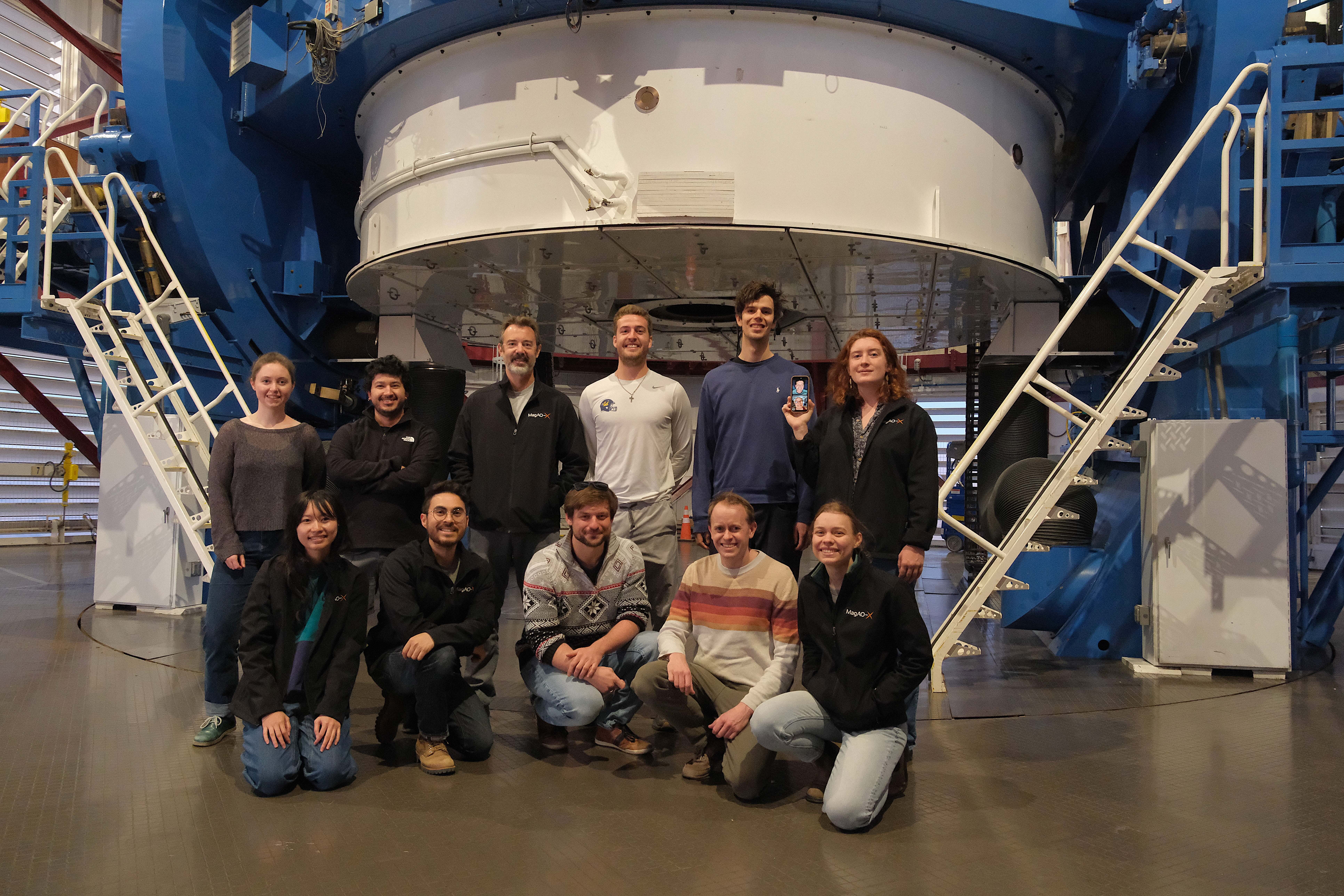
Dr. Robert Harris and PhD candidate Viktoria Kutnohorsky recently returned from the Las Campanas Observatory in Chile. Their goal was to work with the MagAO-X team at the Magellan Clay Telescope to perform tests for the development of a planet characterisation spectrograph, the multicore integral field unit (MCIFU).
For the MCIFU, light is fed through a single-mode multi-core fibre into a spectrograph. The spectrograph then produces an individual spectrum for each spatial element, resulting in a three-dimensional data set.
These measurements require an extremely stable image, which can only be provided by an extreme adaptive optics (ExAO) instrument. MagAO-X is an experimental coronagraphic ExAO system that employs cutting-edge technologies to achieve the highest possible contrast at the smallest inner working angles. This enables observations of exoplanets, circumstellar disks, and other high-contrast or high-resolution astronomical targets. The system is developed by the Extreme Wavefront Control Lab at the University of Arizona.
Rob and Viktoria are here together with Dr. Sebastian Haffert (Leiden University) and are able to use his telescope time to test an infrared camera with the MagAO-X system. Until now, observations have only been carried out in the optical regime. So, they performed initial tests to confirm whether sufficient signal is transmitted in the 900–1700 nm wavelength range. We are pleased to report that the first infrared photon detections have been completed successfully, and that we have now obtained low-resolution spectra of bright calibration stars.
This confirms that nothing stands in the way of further collaboration and hopefully installing and testing the whole MCIFU2 instrument with MagAO-X at the Magellan Clay Telescope in 2027.
Although Rob and Viktoria have returned to the UK, their infrared camera will stay installed on the MagAO‑X system until May performing more scientific observations for the MagAO-X team.
A big thanks goes to the MagAO‑X team for their support, for hosting us on site, and for allowing us to integrate the IR camera into their system. Our gratitude also goes to the telescope operators and the entire staff at Las Campanas Observatory for their hospitality during our stay.
Read more about the journey on the Blog of MagAO-X 2026a: