

/prod01/prodbucket01/media/durham-university/90535-(1).jpg)
Climate and Nature – Living Soils Deliver for Both
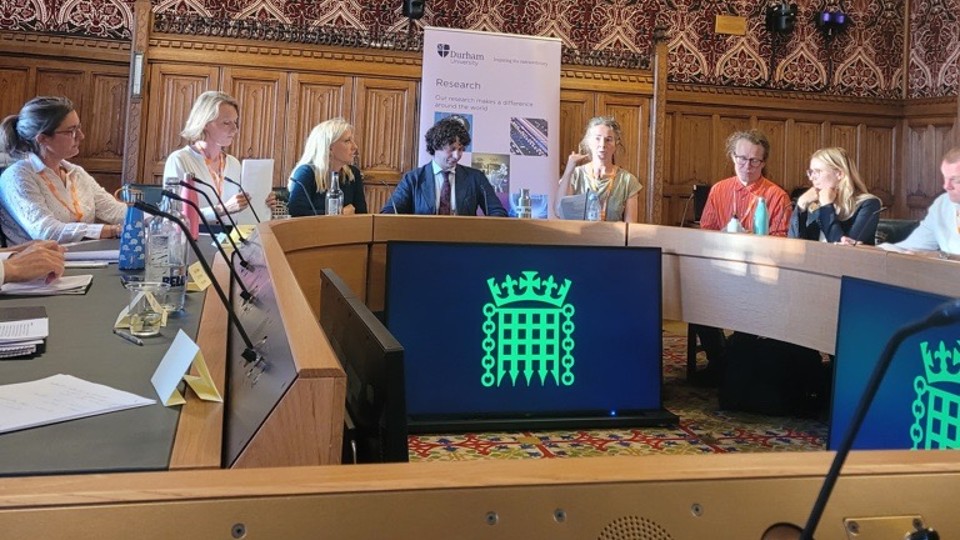
On 8th September 2025, MP Dr Roz Savage MBE hosted a parliamentary round table ‘Climate And Nature – Living soils deliver for both’, in support of her ‘Climate and Nature’ private member's bill. This meeting, organised by Prof Karen Johnson (Durham SMART Soils lead) with Cairo Robb (Durham University) and Ellen Fay from the Sustainable Soils Alliance (SSA), and chaired by Dr Merlin Sheldrake (Fungi Foundation). The panel included experts in public health, housing and infrastructure, education, and the environment. Discussions explored how soil-centric approaches across Government departments could provide a genuine win-win’ solution, enabling us to protect our soils (and hence food security), whilst preserving our natural resources, and accelerating progress on a wide range of other Government priorities.
As Ellen Fay (SSA) explains, “Soil is the 'invisible thread' connecting water quality and food security to flood mitigation and nature recovery. …enabling all other environmental improvements to happen faster and better”
The report from this meeting (published 31st March 2026) highlights that soil-centric approaches must be placed at the heart of planning, policy, and development for the resilience and benefit or our health, economy and wider society.
Rather than an inert material treated as a passive resource where we dump our waste, the report highlights the reality that soil is a living system whose health underpins public health, climate resilience, biodiversity, water regulation, food security and economic stability.
Prioritising soils from the outset in the planning process would unlock a wide range of co-benefits:
- Healthier communities through improved immune and mental health
- A stronger economy through (but not limited to), reduced landfill, lower water treatment costs, increased climate change adaptation and significant potential savings for the NHS
- Contributing to a healthier planet through enhanced carbon storage, flood mitigation, and nature recovery.
A “soils first” approach is therefore essential to delivering integrated outcomes across climate, nature, and society.
At the same time, the report identifies a critical and urgent skills gap in soil literacy, both in the UK and around the world. Despite soil’s fundamental role in our survival, public and professional understanding remains extremely limited. Few people recognise that soil is alive, that interaction with healthy soil can benefit human health, or that soil restoration is directly linked to climate change and ecosystem resilience and biodiversity preservation. Addressing this gap requires systemic change across education, training, and policy. The UK has a major opportunity to lead internationally by embedding soil literacy across sectors, from early education to professional practice, ensuring the knowledge and skills needed to support a soil-centric transition.
- Read the full report here
- More about the Durham SMART Soils team and programme